Showing posts with label Insects. Show all posts

Tuesday, June 4, 2024

Bumblebee Spring

The mountains that rise above the Great Basin are full of surprises. They have been recognized for a long time as sky islands. Often when I make my way up their slopes, I find species of insects and birds that I did not expect to see. 

Bumblebee Spring surprised me in this way last week. It is a moist spot on an otherwise dry slope to the west of Kanarraville (Utah). Saying that it occurs in the Basin and Range province is only barely true. It is within inches of the Mojave Desert (to the south) and the Colorado Plateau (to the east). And rising to the southwest is the Pine Valley Mountains.


Our small team of bee enthusiasts spent three afternoons following feral honeybees and bumble bees in the area looking for nesting sites. We believe that by better understanding where our bees live, we can better understand the ecological relationships that are important to maintain the health of these wild places.


Our first observation (made within minutes of parking the vehicle) was a very large bumblebee. She was over 25 mm long with a prominent black spot on her back between the wings. I  recognized her at once as a Nevada Bumble Bee (Bombus nevadensis). This was a bit of a surprise because of the elevation. We were at 7,400 feet above sea level and this bumble bee is supposed to remain below 7,200 feet. 

Given our location, the sighting is reasonable. Bumble bees are northern insects. They are adapted to cold climates (at least in the winter) and one typically sees them commonly occurring in lowlands when in the north (at least north of Cedar City). Of course there are exceptions, especially as one takes elevation into account. I mean that northern species can occur in southern areas by moving up in elevation. 


What was also surprising was that the bees were feeding aggressively on the lovely bright yellow mountain goldenbanner (Thermopsis montana). Some people call this plant false lupin because of how the pea-like flowers cluster along the stem like lupins. This was a little unexpected because it is not considered a primary foodplant of the Nevada Bumble Bee. 


The bumble bees and flowers were abundant. Warblers and vireos were making all kinds of pleasant sounds in the canopies of Gambel oak. In this little forgotten corner of the West, they are trees even though throughout Utah they are called scrub oaks because of their shrub-like appearance and their habit of forming dense thickets.


Here they form a forest by an intermittent spring and provide shade for a lovely flora and a diverse collection of pollinators. It is one more lovely spot hidden away (and nearly invisible) to the thousands of busy travelers staring at the blacktop in cruise control just a few miles away. 


Thursday, November 16, 2023

Utah and Her Honey Bees

 The state insect of Utah is the honey bee. This is, perhaps, a trivial fact, and one that only an entomologist like me might care to remember. But even though other states (15 to be precise) have chosen the same insect, the story in Utah is unique. We care about these bees as others do. We enjoy eating their honey and benefitting from their pollinating services. But here, the honey bee also looms large as a symbol of a hard-working community surviving in a desert landscape. 


Other places typically decided on their state insects by committee and legislative processes many years after they became states. In Utah, the beehive was a symbol long before statehood was granted. In fact it was a symbol long before there were any state insects at all. The evidence suggests that in Utah it wasn’t a committee that made the decision either. Brigham Young may have come up with the idea himself sometime between July 24, 1847 and July 24, 1848 - the first year that the pioneers lived in the Salt Lake Valley. 


The odd thing about this story is that Utah and her people are not all that interested in honey bees. We certainly have beekeepers and apiaries, and we gather and sell a variety of honeys. We even have a bee lab in Logan where over a million bees are kept in small white unit trays within glass-topped drawers. But these bees are mostly native bees of the Western US. Less than 1% are honey bees. If you ask the majority of Utahns if they know the difference between a honey bee and native Anthophora bee, they would only shrug their shoulders. I know because I do this sort of experiment on a regular basis (not to be cruel, but to make a point). 


And as far as the honey is concerned, we produce less than other states that have never recognized the honey bee as a state insect. My copy of the 2002 Agricultural Statistics has Utah ranked number 23 in the nation in the number of honey producing hives. A skeptical Utahn might say that the low ranking is due to the small population of the state. But the numbers don't follow. Of the five states bordering Utah, only Nevada has fewer hives than Utah. Even sparsely populated Wyoming has more than we do.   


The modern entomologist might find these conflicting points confusing. More so because the beehive symbol shows up all over our state. The proper noun Deseret is perhaps the most obvious example. It was the name of our state before Utah was officially accepted into the Union (as the State of Deseret). It is the name given to bees in the Book of Mormon. The reference comes in the Book of Ether (3:2) where a group of Old World emigrants are traveling to the Americas. The account briefly mentions the conveyance of honey bees to the New World. 


But this reference is a mere sentence in a sacred text consisting of over 500 pages. There is nothing here that would lead anyone to assume an elevated iconic status for an insect. And yet the iconic status persists. We don’t call our state Deseret anymore (at least not very often). And since becoming the 45th state of the Union (in 1896) we are no longer known as the Utah Territory. But Utah is still very much the Beehive State and our flag proudly flies with the image of an old-fashioned hive (a straw skep) front and center.  


In his master's thesis, Michael Hunter argues that the beehive symbol has a long history that begins in monarchical Europe and develops through republican revolutions, and Masonic ritual. In Utah this evolution also included theocratic renewal. It isn’t the insect that matters, he argues, it is the old symbol of an ordered society, of hard work, and of selfless service that impressed itself upon Brigham Young and the Utah Saints. What I find so interesting is that the beehive symbol itself has endured even though our understanding of honey bee biology has changed a great deal in the last 500 years. 


A few hundred years ago we thought that a colony of bees was ruled by a benevolent king bee (Crane, 1999). A king bee was like a divine ruler, wrote Thomas Aquinas: “Among the bees there is one king bee and in the whole universe there is One God, Maker and Ruler of all things.” “The king does not sting,” was an important bee motto of the Renaissance (“Rex Spicula Nescit”, literally translated, the phrase means: “the king does not know how to sting”).


Even before Aquinas there is a long history of assuming queen bees to be kings. Bees were the symbol of kingship in Lower Egypt. And in Ephesus the officials of Artemis were called Essenes (not to be confused with the Jewish sect of Essenes) - a name that is said to refer specifically to the king bee (Hunter, 2004). Some ancient cultures (including Egypt) believed that souls took the form of bees and were watched over by a benevolent male ruler that was partially divine.


By 1609, it had been established that the large bee in the center of beehive activity was actually female. But instead of losing the royal symbol, Europeans just changed the sex of the ruler. He wasn’t a king. She was a queen. Charles Butler, an English rector, wrote that “The Bee-state is an Amazonian or feminine kingdom.” Even so, comparisons continued to be made between bees and kings. 


When the Anglo-Dutch philosopher Bernard Mandeville wrote his Fable of the Bees in 1714, he was not worried about whether bees had kings or queens. Bees were a symbol of social mores writ broadly and his purpose was to show that republican individualism should be the basis of a good society - kings were a burden. The real work of society was performed by the workers, and without the worker bees, the queen would die. 


The ideally functioning hive with its dedicated working class made its way into freemasonry as a symbol of fraternity. For the Shakers it was a symbol of religious community. For the Catholics the beehive was a symbol of a formal church with its well-functioning parts.


As 19th-Century members of the Church of Jesus Christ of Latter-day Saints were pushed out of Ohio, Missouri and finally Illinois, their views of American republicanism developed along different lines than those of either the northern or the southern states. On one occasion Joseph Smith referred to the restored church as a theodemocracy.  Joseph’s successor Brigham Young believed that a theocratic community could exist within the American republic. And it was Brighma Young who established the beehive as Utah’s foremost symbol even as the rest of the country recognized the same insect in different ways.


Val Brinkerhoff argues that the beehive in Utah represented the Kingdom of God. And it was usually depicted underneath the protected talons of our national bird - the bald eagle. These combined symbols (of raptor and hymenopteran) are consistently portrayed together in wood carvings, public monuments and even in church conferences during the administration of Brigham Young.


The truly remarkable part of this history (at least for me) is that the beehive remains a very visible and public symbol in Utah even though it no longer works symbolically as it used to. Our knowledge of bee biology has made some of the earlier symbolic notions unworkable. That said, we are still concerned about bees, at least symbolically. The recent pandemic of colony collapse disorder has been an interesting contrast. The disorder certainly worried the world. Utahns, however, weren't unduly concerned for the bees. It was always the beehive as a symbol that was important and not the bees themselves. 


But the modern interest in honeybees worldwide has to do with their biology and not with their social structure (and its symbolic history). In Utah, however, the symbolism remains. We don’t think of honeybees as ruling monarchs nor as harbingers of a future theocracy. But we do continue to see them as examples of industry, of selfless service, and of an ordered society. It is convenient (and probably proper) to ignore the fact that honeybees, for all their social adaptations, also maintain a caste system. 


I only bring this up because my ancestors were an independent group of tough desert farmers and ranchers. They knew first hand the importance of community but they were also individualists and trusted their own judgment before that of anyone else. They would never have submitted to a caste system, nor was it a part of their faith. I know this from a lifetime of experience belonging to an extended family that hails from very rural and independently-minded sagebrush communities in Utah. 


The Great Plains and the American Midwest may have experienced long periods of conflict between farmers and ranchers. But out here in Utah, by the end of the 19th Century, existence depended on a hardscrabble determination to raise food in whatever way was possible. My ancestors farmed and ranched. And they contracted out their services to locals and governmental employers whenever opportunities presented themselves. 


This combination of pluck and community does have a counterpart among honeybees. Individual worker bees may seem to go about their various jobs as subservient automatons while maintaining the hive, but when they set out on their own to build a new hive, they work very democratically indeed. 


This happens when the old queen can no longer keep new queens from developing within the hive. She becomes restless and gathers a few thousand worker bees to follow her away from the old home and swarm to a nearby branch or other available outpost. Then over the next several hours or days, scout bees go in different directions looking for a suitable place to start over. The decision on the best location is made by the hive as a group. It isn’t a decision made by the old queen nor by a select committee. It truly is a democratic decision (Seeley, 2010).  


The so-called caste system of bees comes from the 20th Century definition of eusociality which states that eusocial organisms: 1) cooperate in rearing young, 2) that there exist overlapping generations within the hive, and 3) that there is a division of labor between reproductive and nonreproductive groups (sometimes called castes). A few authors (including the well-known entomologist E. O. Wilson) have argued that humans display a weak form of eusociality as well. And this might imply that the Utah fascination with honeybees stems from a deeper willingness to accept a sociality of castes. 


Such claims are historically uninformed and misunderstand the self-reliance that is a deep part of our Utah psyche. It was Suzanne Batra (in 1966) who introduced the word “eusocial” in her work on nesting behavior in some sweat bees (very distant relatives of honeybees). And a few years later, the well-known bee taxonomist Charles Michener used the term for other bees (including honeybees) generally. Overlaying this recent understanding of bee biology onto the Utah admiration of bees (stemming from a century earlier) makes no sense. 


Neither should this argument be used for our many modern neologisms like Beehive Credit Union, Beehive Brick, Beehive Pizza; or Deseret Book, Deseret Industries, etc. Utah culture past and present, sacred and secular, biologically informed and otherwise,  is perfused with this symbol. 


Armand Mauss, in his 1994 study of Mormon assimilation, has argued that the beehive symbolism is thematically more important than just traditional industry and hard work. He contrasts the beehive with the symbol of the Angel Moroni that rises with a trumpet on top of many temples. The angel represents the spiritual and revelatory other-worldliness of the restored gospel. The beehive, in contrast, is somewhat of an excuse to be pursue wealth. It is primarily “a symbol of worldly enterprise throughout the Mormon heartland.”


My own take on this contrast is somewhat skewed, yet also informed, by an entomological sensitivity. The bees themselves should not be ignored, and they are tougher than we might expect. The ones that we have kept caged in our wooden hives are struggling to survive the many introduced pathogens and toxic chemicals that modern society continues to generate. The ones that have escaped into the wild and keep themselves in tree holes and rock cavities are doing much better. These are the ones that seem to resist our imposed “assimilation.”


I think there is a lot to be gained by the right kinds of symbols. Beehives and the social insects that live in them must certainly be counted as one of these - both for Utahns and the long apian history of many other lands. But symbols that we inherit, and hardly think about, usually fail. They can only be taken so far. The industrial behemoth that is choking our world (and that is loved by too many Utahns) seems to be looking all too favorably on our many symbolic hives. Somewhere along the way we should stop and pay more attention to the insects themselves and to their preferred wild landscapes. We have exploited them both for far too long. 


References


Batra, S. W. (1968). Behavior of some social and solitary halictine bees within their nests: a comparative study (Hymenoptera: Halictidae). Journal of the Kansas Entomological Society, 120-133.


Brinkerhoff, V. (2013). The Symbolism of the Beehive in Latter-day Saint Tradition. BYU Studies Quarterly, 52(2), 9.


Butler, Charles and John Owen. (2017). The feminine monarchie or the history of bees. Northern Bee Books, Hebden Bridge (prepared from the 1623 edition).


Crane, Eva (1999). The world history of beekeeping and honey hunting. Routledge, New York.


Hunter, Michael J. (2004). The Mormon hive: a study of the bee and beehive symbols in Nineteenth Century Mormon culture. Brigham Young University BYU Scholars Archive. 


Mauss, Armand L. (1994). The angel and the beehive, the Mormon struggle with assimilation. University of Illinois Press, Urbana and Chicago. 


Michener, C. D. (1969). Comparative social behavior of bees. Annual review of entomology, 14(1), 299-342.


National Agricultural Statistics Service (2002). Agricultural Statistics 2002. United States Government Printing Office, Washington. 


Seeley, Thomas D. (2010). Honeybee democracy. Princeton University Press.

Tuesday, October 31, 2023

Wild Honey Bees at Coral Pink Sand Dunes

It took us over six hours to find the hive. It was early October and we were just a few minutes north of the Utah Arizona border on the buffy orange sand at Coral Pink Sand Dunes State Park (in Kanab County, Utah). The sun had been up for an hour or two when Braiden spotted the first honey bee. It was visiting rabbitbrush flowers, intent on finding nectar and not giving a whole lot of thought to the human following along with an insect net in hand. 


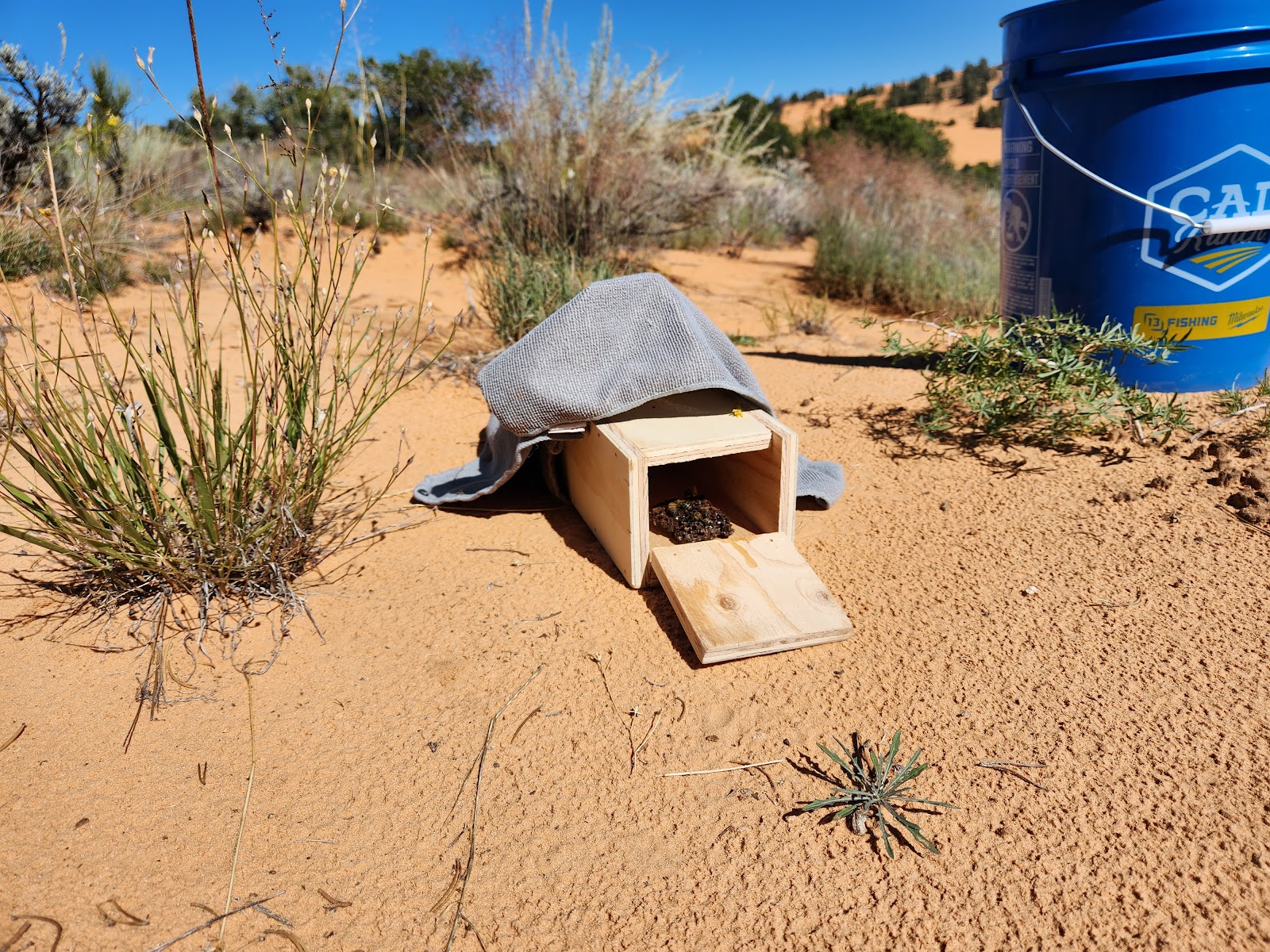
Within moments, Braiden had the insect in his net and was slowly coaxing the angry insect into a wooden container half the size of a shoe box. Once inside, the bee moved to the back of the box where there was light. It was hoping to get out, but in vain. The light was coming through a plexiglass window and the bee was now trapped. Braiden then quietly placed a small bee comb filled with a high concentration of sugar water near the opening and then shut the door. When he then placed a cloth over the window, the box became dark inside and the bee slowly worked its way away from the window to the sugar water.

This is the method developed by George Edgell of Harvard University a century ago, and later optimized by Thomas Seeley of Cornell University. Edgell was a professor of architectural history that happened to love looking for wild bees. His slender book, The Bee Hunter, described his use of the bee box and, perhaps just as importantly, it was used by Seeley many years later who optimized the method through a career studying wild bees in the Arnot Forest near Ithaca, New York. 


Braiden and I decided to make our own boxes based on Seeley’s design. We were impressed that it worked so well even though we were novices and had never followed wild bees before. We knew that we could capture honey bees and get them to drink sugar water. But, before using Seeley’s box, we had not succeeded in following the bees to their hives. I knew that we (humans) have been hunting for bee hives for thousands of years. I imagined that finding them here in Southern Utah would be a good challenge but intuitively doable. It turned out to be quite a bit more challenging than I expected. I gained a new respect for our neolithic ancestors. 


According to Eva Crane, humans have been following wild honey bees for possibly 7,000 years. Rock paintings in the Old World show humans climbing spindly ladders and hanging on ropes in precarious positions in order to get at the honey. One picture I particularly like is on a vase from the Etruscan city of Volci showing mythical honey hunters in a cave on Mount Dikte. A few men (without loincloths) are carrying what look like torches while illuminated bees fly around their heads. 


These examples are all from a time before we developed skeps or wooden hives to keep the bees closer to home. Of all the pictures in Crane’s book, one of the most compelling looks very much like honeycombs on the walls of Catal Huyuk in Anatolia. It was painted by some of the first city-dwellers of our species - at around 6,600 - 7,000 BC. It is evidence that we have had a sweet tooth that we were willing to get stung for - and for as long as we have been gardening. And maybe even for a lot longer than that.


But what about using honey bees to help pollinate our crops? If the part about finding hives to get honey goes back thousands of years. The part about managing bees as pollinators is harder to track. It probably goes back thousands of years as well, but we can’t say for sure. It may be that we have been manipulating pollination for only a few hundred years. 


This hidden history is harder to track because farmers don’t typically write books. The story is also complicated because it involves more than just placing hives in orchards or around gardens. It also includes the honey bees that have escaped from our semi-domesticated and handmade hives and have taken up residence on their own wherever they can find a suitable cavity with a suitable hole - Meaning an entrance that allows them to protect themselves from the many creatures that want to eat their honey, their brood, and even their sisters. 


Sometimes these wild colonies find a tall tree with a hollowed-out core. A woodpecker hole, perhaps, or even a piece of rotted heartwood from a broken branch. The bees like to be well above ground level where it is harder for mammals such as bears to find them, or to leverage their weight against their home and break inside to get at the honey. In urban areas, bees have been known to start a colony on their own in old abandoned houses, or in the eaves of apartment buildings. Most cities have a beekeeper or two that can be called on if a colony-forming swarm happens to converge somewhere that causes panic. After all, hundreds (even thousands) of bees landing on your back porch can feel like something out of an Alfred Hitchcock movie. 


In Utah these wild honey bees are poorly known. We occasionally have a determined beekeeper that will move hives to a wild place in order to crossbreed domestic bees with wild drones. But that is about it. In Arizona Gerald Loper, Steve Tabor and a dedicated team of bee enthusiasts have located several wild honey bee colonies in the Sonoran Desert. These bees are mostly found in rock cavities with only a few establishing colonies in old walnut or mesquite hollows.


Our first effort in Utah suggests that the wild honey bees here are also finding suitable nest sites in scrubbier habitats. I assumed that they might also be nesting in rocks. But it turned out that I was wrong - at least on this occasion. After Braiden’s single captured bee had taken its fill of sugar water, it flew out of the bee box and proceeded to circle the area as it flew higher and higher into the air and then headed off to the west and away from the dunes. 


After a few minutes, the bee returned and a pattern of feeding from the bee box, flying off to the west, and returning was repeated several times. The area to the west of the dunes is dominated by pinyon pines and junipers. These trees are substantially shorter than the high canopies of the eastern forests where Seeley did most of his work. It is also an area of small cliffs and broken rocks and we assumed that the bees would have greater luck finding cavities here than in the relatively smaller trees. 


Once away from the sand, Braiden (and his wife Keesha) continued working with their bee box and following the flight path along a road paralleling the cliff (and paralleling the road to the park). I decided to head towards the cliffs and see what I could find. I also set up a bee box and began tracking bees closer to the rocks. 


In Seeley’s account of finding wild honey bees, he makes a point of placing a drop of paint on the backs of some of the bees. He does this in order to time individual bees. If the painted bee takes several minutes to leave from the bee box and return for more sugar water, then the hive is likely to be over a mile away and may be difficult to find. As the bee hunter moves along the bee line, however, and the time is lessened, the bee hunter knows that the hive is not far away. 


Both Braiden and Keesha following their bee line, and I (following mine) were watching bees return to the bee box after just two or three minutes. We knew we were getting close to the hive, but as beginners, we weren’t quite sure of when we should leave the boxes and start canvassing the area looking for hives. 


I was scouting among the rocks and even started climbing the more accessible parts of the cliff, but without success. Ravens and scrub jays were wondering what I was up to. They circled above the trees and hopped from pinyons to junipers scolding me. Even a flock of bushtits flew out of their way to see what I was doing. 


Back at my bee box, I found dozens of bees loading up on liquid sugar but I was having a difficult time determining the direction of their flight home. The problem was that I was too deep in a small wash and there wasn’t enough of a blue horizon to see the bees once they flow just a few dozen feet away. A few dozen feet, I might add, is quite a distance when you are staring at a cliff or a pinyon copse as background. 


So I loaded my bee box and supplies into my bucket and found a broken part of the cliff that was only 50 feet high. Using my old insect net (that I have fashioned out of a golf club) as a walking stick, I scrambled to a place that had more sky to look at and then reopened the box. By now the afternoon was turning into evening and I had been out for over six hours with only a bit of water to drink. I was getting tired, but the bees seemed to be flying to the east now. It seemed that I had over-shot their hive while climbing. 


I was about to call it a day and come back later to start again when I ran into Braiden and Keesha just over a small hill. Their bee box was full of bees and, perhaps more interesting, the bees were heading south. We sat and watched the bees come and go so quickly that we couldn’t bring ourselves to leave just yet. We now had three different directions to consider and our best guess was that the hive must be somewhere on the cliff and not very far away. 


We weren’t all that excited to try our luck scrambling back down the cliff, but we decided that a general reconnaissance wouldn't hurt. No sooner had we started looking around when we found it. Bees were flying at a regular pace in and out of an old juniper. It was actually at the base of the tree right above the rocks forming the beginning of the cliff. Some years ago (probably many years ago) the tree had split at the base leaving a cavity into which the bees had settled. 


I scooted under some old branches to have a closer look and in my excitement managed to smash my head on a snag. Braiden and Keesha were just as excited and decided to celebrate the way newlyweds are wont to do. We had just succeeded in finding our first wild bee colony. It wasn’t in a tall tree, nor was it in a rock cavity or a walnut burl. It was in a place that looks a lot like Southern Utah - an old juniper surrounded by sage and rabbitbrush. The big question remains in the back of our minds: where else might they be hiding?


References


Crane, Eva. 1999. The world history of beekeeping and honey hunting. Routledge, New York.


Edgell, G.H. 1949. The bee hunter. Harvard University Press, Cambridge, Massachusetts.


Lloyd-Jones DJ, St Clair JJH,Cram DL, Yassene O, van der Wal JEM,Spottiswoode CN. 2022 When wax wanes:competitors for beeswax stabilize rather than jeopardize the honeyguide–human mutualism.Proc.  R.  Soc.  B289: 20221443.


Gerald M. Loper, Diana Sammataro, Jennifer Finley and Jerry Cole. 2006. Using Global Positioning Satellite (GPS) to Relocate Feral Honey bees in Southern Arizona, 10 years after Varroa infestation. USDA Carl Hayden Bee Research Center, Tucson, AZ.


Seeley, Thomas. 2016. Following the wild bees, the craft and science of bee hunting. Princeton University Press. 


Seeley, Thomas D. 2019. The lives of bees, the untold story of the honey bee in the wild. Princeton University Press.

Friday, October 13, 2023

Dusted Bees

 I recently found myself early in the morning in a parking lot next to the Virgin River with an hour to spare. The sun was just creeping through the eastern hills and the good people of Saint George were largely asleep. It was the weekend and the parking lot was nearly empty. An old man driving a big red dually was the only other person around. 

It was a chess tournament that brought me to Saint George. A few weeks earlier our SUU chess team was invited to a tournament at Utah Technical University. Our players were eager to participate but because chess is a niche game, we are not supported by university athletic funds and so have to pay our own way. This shoestring existence occasionally has its perks. It sometimes takes me to interesting places where I don’t have to feel guilty looking for insects and birds, since I’m covering all the travel costs myself. This particular morning it found me in an abandoned field by a parking lot where the only insects I could find were honey bees.


I don’t normally give honey bees much attention. They are not native to Utah even though we recognize them as our state insect. A few of my entomologist friends go so far as to call them an invasive species. I disagree. They do compete with our native bees in places, but the American West is not their ideal habitat and they have not become “weedy” in any significant way. We lack the many hollow tree trunks that are their preferred nesting sites in out-of-the-way places. We also benefit a great deal from their pollination services. Many varieties of apples, apricots, peaches, etc., bloom when our native bees are still sound asleep in the early spring. Only honey bees (with their winter store of honey and pollen) are available to do the work.  

Even though it was still early, the temperature was in the high 60’s and the desert air was moist from recent rains. I was hoping to find a few morning wasps, or beetles perhaps, but not much was out except a handful of mushrooms that were pushing through the hard-packed soil between tumbleweeds and clump grass. And so I started following the bees. 


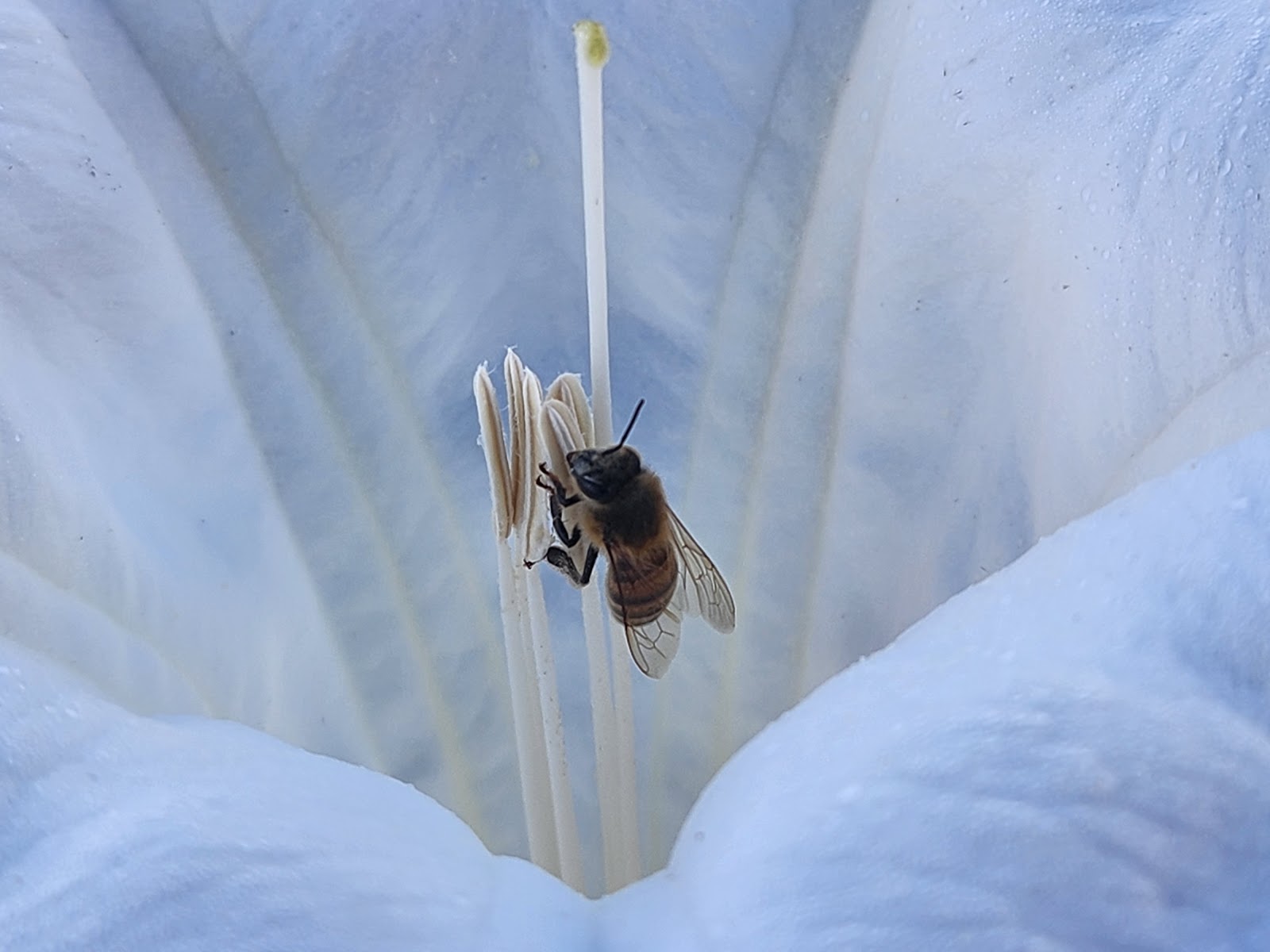
They were visiting large white jimsonweed flowers (Datura stramonium) that were still wide open. This was their chance, I thought. Jimsonweed flowers would seem to be a significant source of nectar and pollen to a lot of desert species. They are beautifully trumpet-shaped and noticeable from a distance. The only trouble is that they remain open primarily at night. Diurnal pollinators like most bees don’t have much of a chance. It is the night-flying hummingbird moths with their long tongues that get most of the nectar.


But these early-rising honey bees also seemed to be getting their share of the flowers before the large white petals closed up for the day. It was a narrow window of light and open flowers when the hummingbird moths were no longer active and couldn’t push them away. 


As I watched I didn’t see the bees digging deep into the corollas after nectar. They were clinging to the long styles and seemed intent to just hold on, nibbling now and then at the cream-colored stigmas that were holding the pollen. It also seemed to me that they were getting drunk. 


A casual observer might think they were just cold. After all, they weren’t very active. A lot of flower-visiting insects can be easily approached in the morning because cool temperatures make it very difficult for them to move. Often they spend the night on the petals and wait for the temperature to rise to an acceptable point. This is usually in the 60’s or 70s depending on the species. Seeing honey bees moving slowly on a big white flower in the morning might seem natural. And I have to admit, I didn’t pay much attention to it at first.

But honey bees don’t follow this pattern - at least not when they are sober. It occurred to me as I was wandering from flower to flower that they don’t sleep outside. They spend the night in their hives protected, and warming themselves, by the side of hundreds (maybe thousands) of their sisters. So if you find a honey bee on a flower in the morning, it means that it flew to that flower fairly recently. Realizing this, I started paying closer attention to their behavior. 


And their behavior was odd. Not only were they slow moving but they seemed oddly tentative about flying - as if they wanted to move but that something was holding them back. When they did manage to launch themselves into the air, they looked like miniature ravens being blown around in a windstorm. They pointed themselves in one direction but were flying in another.


Honey bees sometimes fly this way. If a foraging bee happens upon a rich source of nectar, she will lift her heavy recently-filled abdomen somewhat deliberately from the flower and fly in circles or figure eights as she slowly lifts herself into the air. She is memorizing the location of her find and sometimes does fly backwards or sideways as she does so. Once she has fixed the location in her find into her insect-sized brain, she flies in a more direct way back to the hive to inform the others. But what I was seeing was different. I watched as bees would start to fly and then bump into a leaf before getting above the flowers. Sometimes they would lose their horizontal position and veer one way or another. 


Bees don’t fly this way when they are visiting different flowers. Sometimes it looks like they are half jumping and half flying but their movement is more directed. They are looking and smelling for flowers that have sugary rewards. The bees I was watching emerge from the jimsonweed were acting in ways that were known bee behaviors but in ways that were out of context. And I started wondering if they really might be drunk or somehow intoxicated.  


I didn’t have time to continue watching. The chess tournament was about to start and I had to hurry back into town. It turned into a fun event. We won most of the matches and every player was a good sport. Not everyone, however, was entirely magnanimous. During the fifth and final round, as our third strongest player finished his game (and won) I mentioned to him in a hushed tournament-appropriate voice that our team was finishing strong. He jokingly replied that he hoped our top players would lose or tie their games. He was suggesting that he might end up placing higher in the tournament if they performed poorly. And, in fact, there were a couple of scenarios where their losses could have played out in his favor.  


I wasn’t amused. My priorities, as the team's coach, was for the entire group to do well. I smiled noncommittally and continued to encourage our other players in the only way I know how: quietly and with attention observing their games. The thought of teammates lacking social graces, however, was still in the back of my mind.


Then I remembered the dusted bees flying haphazardly and bumping into leaves. They were not managing their social lives very well either. They were stuck on flowers that offered them treats but that were altering their brain chemistry. Instead of flying back to the hive where sister bees would unload their sugary loads for the benefit of everyone, they were struggling to find their way. 


I suddenly felt sorry for my gifted chess player. Like most of his colleagues and friends his life was deeply embedded in the gaming community with its brain-altering addictions. I knew that on many occasions, he was unable to break free of the computer screen. Like the bees, his personal intoxication was keeping him from feeling part of our team. 


Bethany Teeters and a few of her associates noticed that when honey bees are exposed to certain insecticides, they don’t move as much. Not only are they more hesitant to fly but they also stay for longer periods of time near a food source. This seemed to be the behavior of the bees I was watching. Was it a general pattern for other species as well? 


Jimsonweed is a member of the nightshade family - a group of plants that are known for making all kinds of protective compounds that are harmful to animals. But since honey bees are not native to North America there seems little likelihood that the two species have been adapting in any meaningful mutualistic ways. Perhaps the plant was getting pollinated, and maybe the bees were eventually finding their way home. But the whole situation was out of context. An insect from a distant land was getting intoxicated on a native plant in a weedy field next to a desert parking lot. What a tragedy of errors.


Jimsonweed poisoning interferes with nerve cells. In high enough concentrations it is lethal. Unfortunately it is also hallucinogenic and the concentration separating dangerous amounts of the toxins and the psychological effect is fairly small. 


In 2015, Sean Spina and Anthony Taddei reported on a case of teenagers being admitted to emergency care after eating several hundred jimsonweed seeds. They experienced visual hallucinations for sure, but also became disoriented, began mumbling incoherently, and their eyes became less responsive. Knowing that the plant can also cause delirium and even seizures, doctors kept the patients under supportive care and administered activated charcoal to mollify their digestive discomfort. They were fortunate and recovered. 


Bees and humans are not related other than by the fact that we are both animals. Even so, if you compare the DNA of small fruit flies (the so-called insect lab rats in the genus Drosophila) and humans, it turns out that we share roughly 60% of our genes. This means that most of our metabolic pathways are the same - including some of the ways we process nerve signals. 


For hundreds of years the Navajo have recognized both the narcotic and hallucinatory nature of jimsonweed. They left it alone because it could be dangerous, unless someone was a victim of theft. If the stolen item was valuable enough to risk getting sick, the victim would first make an offering of turquoise and pollen. Then a small hole would be dug and a section of jimsonweed root would be removed. The piece had to be at least several inches long but not long enough to kill the plant. 


After chewing half of the retrieved portion, the victim would soak the rest in water for several hours before drinking the solution. Within a few hours one of three things was expected to happen: the victim would “sleepwalk” through the village and stumble upon the stolen item or the thief; the victim might hear voices (sometimes plants began speaking) giving directions to the find; or, more commonly, the victim would fall into a trance and see the stolen item or the thief in vision (Hill, 1938). 

I can’t help but imagine - somewhat facetiously - if the poor honey bees were not having dreams of nectar-filled flowers. More relevant, perhaps, is the realization that plants and animals have been elbowing each other around for millions of years in order to make a place for themselves in a challenging world. Plants don’t offer up their goods for the fun of it. 


Living in a world that has large corporations spending billions of dollars trying to sway our minds with modern forms of narcosis, I can’t help but see a cautionary tale in the jimsonweed and the bees. Maybe the Navajo had it right. We should only partake when we really need to. 


References


Decourtye, A., & Devillers, J. (2010). Ecotoxicity of neonicotinoid insecticides to bees; Chapter 8 in: Insect nicotinic acetylcholine receptors, 85-95.


Hill, W. W. (1938). Navajo use of jimsonweed. New Mexico Anthropologist, 3(2), 19-21.


Raguso, Robert A., Cynthia Henzel, Stephen L. Buchmann, and Gary P. Nabhan. 2003. Trumpet flowers of the Sonoran Desert: floral biology of Peniocereus cacti and sacred Datura. International Journal of Plant Science 164(6), 877-892. 


Spina, Sean P. and Anthony Taddei. (2015). Teenagers with jimson weed (Datura stramonium) poisoning. Canadian Journal of Emergency Medicine, 9(6), 467-469.


Teeters, B. S., Johnson, R. M., Ellis, M. D., & Siegfried, B. D. (2012). Using video‐tracking to assess sublethal effects of pesticides on honey bees (Apis mellifera L.). Environmental Toxicology and Chemistry, 31(6), 1349-1354.


Weiler, Elizabeth. (May 19, 2023). The Beehive State is ranked among worst beekeeping states, kslnewsradio.com. 


Wink, M. (2018). Plant secondary metabolites modulate insect behavior-steps toward addiction?. Frontiers in Physiology, 9, 364.

Yard decorations are optional

Before you go out and buy any more yard decorations for the holidays please ask yourself the following questions. Are you buying them becaus...