Showing posts with label Red Rock Country. Show all posts

Tuesday, October 31, 2023

Wild Honey Bees at Coral Pink Sand Dunes

It took us over six hours to find the hive. It was early October and we were just a few minutes north of the Utah Arizona border on the buffy orange sand at Coral Pink Sand Dunes State Park (in Kanab County, Utah). The sun had been up for an hour or two when Braiden spotted the first honey bee. It was visiting rabbitbrush flowers, intent on finding nectar and not giving a whole lot of thought to the human following along with an insect net in hand. 


Within moments, Braiden had the insect in his net and was slowly coaxing the angry insect into a wooden container half the size of a shoe box. Once inside, the bee moved to the back of the box where there was light. It was hoping to get out, but in vain. The light was coming through a plexiglass window and the bee was now trapped. Braiden then quietly placed a small bee comb filled with a high concentration of sugar water near the opening and then shut the door. When he then placed a cloth over the window, the box became dark inside and the bee slowly worked its way away from the window to the sugar water.

This is the method developed by George Edgell of Harvard University a century ago, and later optimized by Thomas Seeley of Cornell University. Edgell was a professor of architectural history that happened to love looking for wild bees. His slender book, The Bee Hunter, described his use of the bee box and, perhaps just as importantly, it was used by Seeley many years later who optimized the method through a career studying wild bees in the Arnot Forest near Ithaca, New York. 
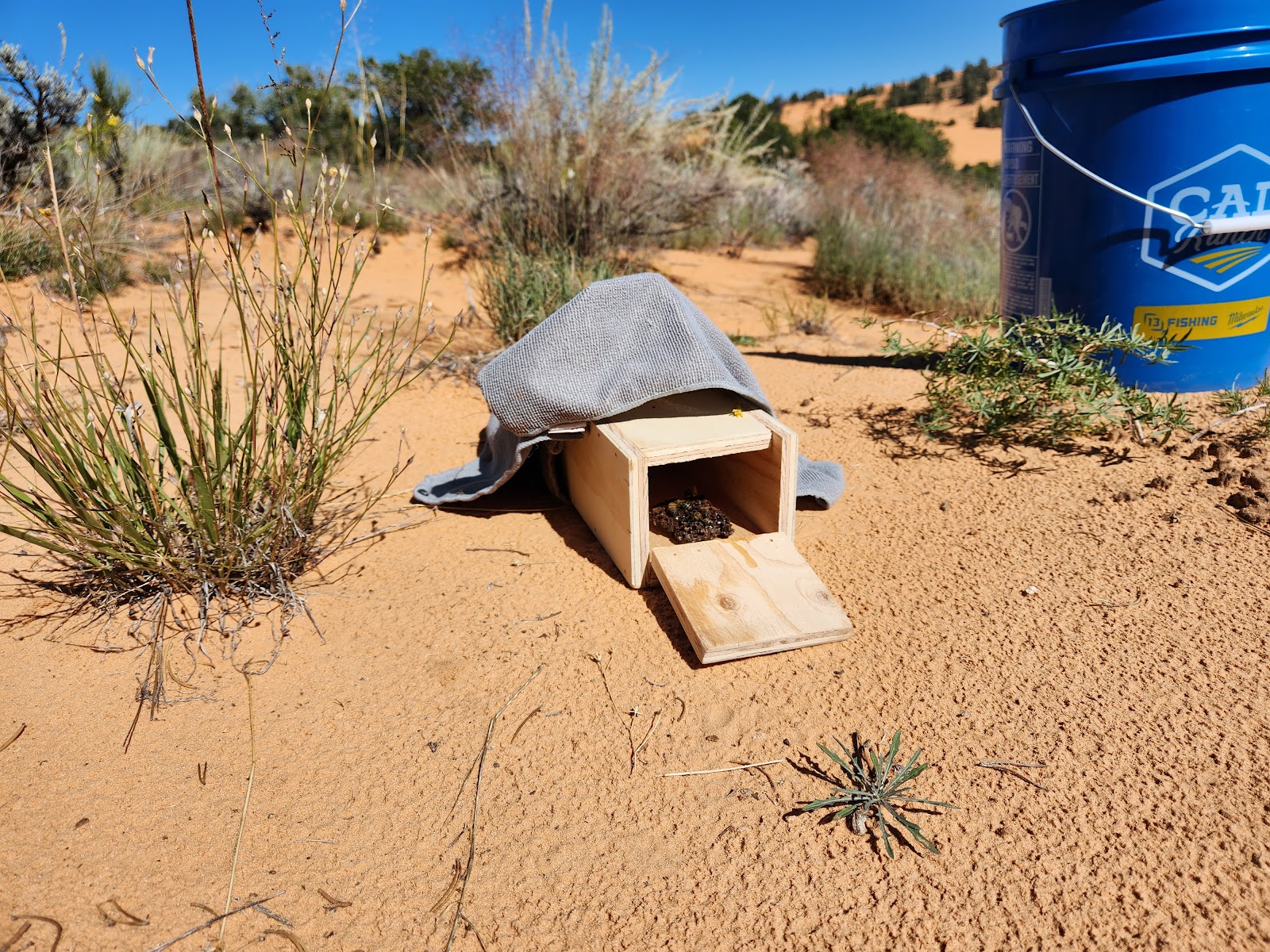


Braiden and I decided to make our own boxes based on Seeley’s design. We were impressed that it worked so well even though we were novices and had never followed wild bees before. We knew that we could capture honey bees and get them to drink sugar water. But, before using Seeley’s box, we had not succeeded in following the bees to their hives. I knew that we (humans) have been hunting for bee hives for thousands of years. I imagined that finding them here in Southern Utah would be a good challenge but intuitively doable. It turned out to be quite a bit more challenging than I expected. I gained a new respect for our neolithic ancestors. 


According to Eva Crane, humans have been following wild honey bees for possibly 7,000 years. Rock paintings in the Old World show humans climbing spindly ladders and hanging on ropes in precarious positions in order to get at the honey. One picture I particularly like is on a vase from the Etruscan city of Volci showing mythical honey hunters in a cave on Mount Dikte. A few men (without loincloths) are carrying what look like torches while illuminated bees fly around their heads. 


These examples are all from a time before we developed skeps or wooden hives to keep the bees closer to home. Of all the pictures in Crane’s book, one of the most compelling looks very much like honeycombs on the walls of Catal Huyuk in Anatolia. It was painted by some of the first city-dwellers of our species - at around 6,600 - 7,000 BC. It is evidence that we have had a sweet tooth that we were willing to get stung for - and for as long as we have been gardening. And maybe even for a lot longer than that.


But what about using honey bees to help pollinate our crops? If the part about finding hives to get honey goes back thousands of years. The part about managing bees as pollinators is harder to track. It probably goes back thousands of years as well, but we can’t say for sure. It may be that we have been manipulating pollination for only a few hundred years. 


This hidden history is harder to track because farmers don’t typically write books. The story is also complicated because it involves more than just placing hives in orchards or around gardens. It also includes the honey bees that have escaped from our semi-domesticated and handmade hives and have taken up residence on their own wherever they can find a suitable cavity with a suitable hole - Meaning an entrance that allows them to protect themselves from the many creatures that want to eat their honey, their brood, and even their sisters. 


Sometimes these wild colonies find a tall tree with a hollowed-out core. A woodpecker hole, perhaps, or even a piece of rotted heartwood from a broken branch. The bees like to be well above ground level where it is harder for mammals such as bears to find them, or to leverage their weight against their home and break inside to get at the honey. In urban areas, bees have been known to start a colony on their own in old abandoned houses, or in the eaves of apartment buildings. Most cities have a beekeeper or two that can be called on if a colony-forming swarm happens to converge somewhere that causes panic. After all, hundreds (even thousands) of bees landing on your back porch can feel like something out of an Alfred Hitchcock movie. 


In Utah these wild honey bees are poorly known. We occasionally have a determined beekeeper that will move hives to a wild place in order to crossbreed domestic bees with wild drones. But that is about it. In Arizona Gerald Loper, Steve Tabor and a dedicated team of bee enthusiasts have located several wild honey bee colonies in the Sonoran Desert. These bees are mostly found in rock cavities with only a few establishing colonies in old walnut or mesquite hollows.


Our first effort in Utah suggests that the wild honey bees here are also finding suitable nest sites in scrubbier habitats. I assumed that they might also be nesting in rocks. But it turned out that I was wrong - at least on this occasion. After Braiden’s single captured bee had taken its fill of sugar water, it flew out of the bee box and proceeded to circle the area as it flew higher and higher into the air and then headed off to the west and away from the dunes. 


After a few minutes, the bee returned and a pattern of feeding from the bee box, flying off to the west, and returning was repeated several times. The area to the west of the dunes is dominated by pinyon pines and junipers. These trees are substantially shorter than the high canopies of the eastern forests where Seeley did most of his work. It is also an area of small cliffs and broken rocks and we assumed that the bees would have greater luck finding cavities here than in the relatively smaller trees. 


Once away from the sand, Braiden (and his wife Keesha) continued working with their bee box and following the flight path along a road paralleling the cliff (and paralleling the road to the park). I decided to head towards the cliffs and see what I could find. I also set up a bee box and began tracking bees closer to the rocks. 


In Seeley’s account of finding wild honey bees, he makes a point of placing a drop of paint on the backs of some of the bees. He does this in order to time individual bees. If the painted bee takes several minutes to leave from the bee box and return for more sugar water, then the hive is likely to be over a mile away and may be difficult to find. As the bee hunter moves along the bee line, however, and the time is lessened, the bee hunter knows that the hive is not far away. 


Both Braiden and Keesha following their bee line, and I (following mine) were watching bees return to the bee box after just two or three minutes. We knew we were getting close to the hive, but as beginners, we weren’t quite sure of when we should leave the boxes and start canvassing the area looking for hives. 


I was scouting among the rocks and even started climbing the more accessible parts of the cliff, but without success. Ravens and scrub jays were wondering what I was up to. They circled above the trees and hopped from pinyons to junipers scolding me. Even a flock of bushtits flew out of their way to see what I was doing. 


Back at my bee box, I found dozens of bees loading up on liquid sugar but I was having a difficult time determining the direction of their flight home. The problem was that I was too deep in a small wash and there wasn’t enough of a blue horizon to see the bees once they flow just a few dozen feet away. A few dozen feet, I might add, is quite a distance when you are staring at a cliff or a pinyon copse as background. 


So I loaded my bee box and supplies into my bucket and found a broken part of the cliff that was only 50 feet high. Using my old insect net (that I have fashioned out of a golf club) as a walking stick, I scrambled to a place that had more sky to look at and then reopened the box. By now the afternoon was turning into evening and I had been out for over six hours with only a bit of water to drink. I was getting tired, but the bees seemed to be flying to the east now. It seemed that I had over-shot their hive while climbing. 


I was about to call it a day and come back later to start again when I ran into Braiden and Keesha just over a small hill. Their bee box was full of bees and, perhaps more interesting, the bees were heading south. We sat and watched the bees come and go so quickly that we couldn’t bring ourselves to leave just yet. We now had three different directions to consider and our best guess was that the hive must be somewhere on the cliff and not very far away. 


We weren’t all that excited to try our luck scrambling back down the cliff, but we decided that a general reconnaissance wouldn't hurt. No sooner had we started looking around when we found it. Bees were flying at a regular pace in and out of an old juniper. It was actually at the base of the tree right above the rocks forming the beginning of the cliff. Some years ago (probably many years ago) the tree had split at the base leaving a cavity into which the bees had settled. 


I scooted under some old branches to have a closer look and in my excitement managed to smash my head on a snag. Braiden and Keesha were just as excited and decided to celebrate the way newlyweds are wont to do. We had just succeeded in finding our first wild bee colony. It wasn’t in a tall tree, nor was it in a rock cavity or a walnut burl. It was in a place that looks a lot like Southern Utah - an old juniper surrounded by sage and rabbitbrush. The big question remains in the back of our minds: where else might they be hiding?


References


Crane, Eva. 1999. The world history of beekeeping and honey hunting. Routledge, New York.


Edgell, G.H. 1949. The bee hunter. Harvard University Press, Cambridge, Massachusetts.


Lloyd-Jones DJ, St Clair JJH,Cram DL, Yassene O, van der Wal JEM,Spottiswoode CN. 2022 When wax wanes:competitors for beeswax stabilize rather than jeopardize the honeyguide–human mutualism.Proc.  R.  Soc.  B289: 20221443.


Gerald M. Loper, Diana Sammataro, Jennifer Finley and Jerry Cole. 2006. Using Global Positioning Satellite (GPS) to Relocate Feral Honey bees in Southern Arizona, 10 years after Varroa infestation. USDA Carl Hayden Bee Research Center, Tucson, AZ.


Seeley, Thomas. 2016. Following the wild bees, the craft and science of bee hunting. Princeton University Press. 


Seeley, Thomas D. 2019. The lives of bees, the untold story of the honey bee in the wild. Princeton University Press.

Saturday, August 12, 2023

Harvester Ants and Horned Lizards

July threatened to leave our meadow hot, windy and in need of rain. The summer monsoons were delayed and the garden was asleep. Paper wasps were still zigzagging slowly through the tall clump grass looking for things to eat, but most everything else was waiting for a break from the heat. 


One morning I walked outside before the sun came up and found four bucks - all sporting nearly full racks - nibbling on my grapes and cherry trees. I was mad. They had been taking their fill of the garden all year, and although I didn’t mind their leftover scat, I didn’t appreciate how much they had taken from some of my young trees. A small crabapple, a newly transplanted cherry tree, and a young serviceberry were almost completely defoliated and were barely hanging on. 


Our yard is a magnet for deer. It doesn’t matter that I am surrounded by neighbors with traditional (I mean non-native) plants that they might eat. The deer know that there are many of their native favorites in our yard, and that these are mixed in with savory fruit trees that seem to add a tasty supplement to their typical diet. They are willing to walk several blocks through developed neighborhoods in order to get to our yard. And they remember the way. And, once they get here, they know where each of our tasty plants can be found. 


Kathy is always slightly amused when I storm into the house cursing the deer. “We have created a meadow of native plants to encourage wildlife,” she reminds me. “And deer happen to be wildlife!” This is certainly true. And even though I am an entomologist and spend most of my efforts working with insects. The deer are not invasive in any natural sense. I grit my teeth and vow to keep waking up early to chase them away. 


This time, as I shooed the interlopers out of the yard, I noticed that one of them stepped right on top of a harvester ant mound. I checked on it later that day. It was alive with ants in the act of repairing the damaged mound. They didn’t seem bothered by the heat, but the other four mounds in the yard remained quiet. It was too hot for them and they had closed their mounds, blocking the entrances and calling all foragers back inside.  


Then we got an hour of rain on the last day of July. It was the first significant rain of the summer, the kind that makes your nares instinctively flare with delight. We sat out on the deck watching the sun go down enjoying the golden light on the cottonwoods in a kind of midsummer aromatherapy.


The next day was August and the forecast was for rain showers off and on for five days in a row. I was thrilled and went outside to let the ants know. They, of course, didn’t need any announcement from me. Their mounds were fully open and they were busy scouring the meadow for seeds and expiring arthropods. It’s funny how a large pogo mound can seem completely vacant one day and teeming with activity the next. 


Not far away on a small berm near an aspen, I almost stepped on another creature that was very happy to see the ants again: one of the three horned lizards (Phrynosoma hernandesi) that I know live in our meadow. It was already fat before the ants closed their doors in July and it certainly didn’t look under-nourished now, but it had gone without its primary food (ants) long enough. 


I’m always impressed every time I see one of these reptiles milling around pogo mounds. Occasionally they position themselves right on the mound itself. But most of the time they wait by the side of a trail and snatch up ants as they march past. It's fascinating to watch because they make it look so easy. There is no running and pouncing on their prey. And they don’t extrude a long tongue like a chameleon. They just capture one ant at a time in a lightning fast thrust of the head. If an ant moves out of range, it doesn’t bother to chase after it. It just waits until another ant comes marching along the trail. 


This habit of remaining perfectly still with the occasional head thrust gives the horned lizard a virtual cloak of invisibility. Ants confront the world (and especially each other) via chemical signals. They have “taste buds” (scientists call them  chemoreceptors) all over their bodies. One of these chemical signals is a distress signal that warns other ants of danger. But horned lizards can usually feed for many minutes without eliciting a warning signal of any kind. They are just too fast and take the hapless ants without warning and engulf them completely in their mouths. It appears as if the ants never even notice as their sisters get picked off one by one. 


But it turns out that the lizards have more up their sleeves - or maybe it would be better to say that they have more in their stomachs. When they snatch up the ants, they don’t take time to chew them. They are grabbed and swallowed whole. Maybe this doesn't seem like a big deal. We swallow large chunks of food all the time and never give it a second thought (even though this is not really a good nor a safe practice). But pogos are not the typical food. They are listed in some studies as having the nastiest arthropod venom around. Patricia Schmidt et al. (1989) write that “their venom has the highest known lethality to mice.” You would think that the horned lizards might be a little more cautious. 


The surprise is that they don’t have to be cautious. They aren’t in any danger. Something in their blood protects them from even very high concentrations of venom. And their stomachs are also unusual. When the ants are swallowed, most of them are still alive and capable of stinging. But the ants contain a viscous mucus that mucks them up. Even if the ants do sting a lizard’s stomach, it is many times more protected from the venom than other reptiles. Schmidt’s study found them over a thousand times more protected than mice. 


It does happen that a horned lizard occasionally gets overwhelmed by ants. I have never seen this happen in Southern Utah where both the reptiles and the ants have lived together for millions of years and have worked out a symbiosis that works well. In other parts of the country, however, the situation is different. In Texas, the invasive red imported fire ant (Solenopsis invicta) has taken over many areas formerly occupied by native ant species. 


Twenty years ago, a couple of herpetologists noticed that the horned lizards in their research area were behaving unusually. If the reptiles disturbed the aggressive fire ants and remained still, as this is their typical response, the ants would attack. If a few of the ants crawled over their bodies and started stinging them they would only close their eyes and wait. They would only eat the ants if they happened to get close to the mouth. If 20 or more ants ended up attacking them, however, this changed. They sprinted away from the fire ant mound and buried themselves in the soil. First they would wiggle their tails and then lower the rest of their bodies until they were completely covered. A few seconds later, the ants would emerge above ground, leaving the horned lizards alone (Webb and Henke, 2003). Somehow, the horned lizards intuited enough math to know the number of ants (and their toxins) that would swamp the protective enzymes in their blood. 


Many ants (including pogos) demonstrate what scientists call sting autonomy. This is a practice seen in some social hymenoptera (like wasps, bees and ants) where individuals will sting a threatening animal for the protection of the colony even though it means death for the stinging individual. Not all of the hymenoptera that carry stingers die when they sting. The ones that do (like honeybees) have developed a stinger that gets stuck in the skin of the unlucky subject. I often hear students commenting on how bad this seems for the bees. Why haven’t they evolved stingers that don’t get embedded in the skin of the target animal - like wasps, for example? 


In fact the barbed stingers - and the death that follows to the bees - are part of the reason for the success of this kind of sting. By leaving the stinger and the venom sack stuck in the victim after the adult bee has been swatted away, the pain of the venom is able to act more quickly and be delivered in greater quantity, thus reinforcing the warning to leave the bees, their home, and all that sweet honey alone (Schmidt, 2016). 


We usually talk about the sting autonomy of honeybees but harvester ants are also known to sting this way, even though it isn’t a human that they typically sting. If a human happens to walk inadvertently on a pogo mound, she will likely feel the ants crawling on her legs before getting stung - and have time to brush them off. This is not always the case with other predators. 


But horned lizards are rarely (if ever) attacked by native ants - not even harvester ants. I have never seen it happen, nor have I read any accounts of it happening. They aren’t agile enough to grab ants that might be crawling over their body. But they can run away and are quite fast if the need arises. And if they do get stung a few times, it doesn’t seem to bother them at all - at least that’s how it appears to humans that are not experiencing the stings themselves. 


These handful of adaptations for eating ants are shared by a disparate group of animals known as myrmecophages. Myrmecophagy is the technical term for ant-eating. Some spiders are myrmecophagous. Vertebrates like pangolins, echidnas, numbats, ant-eaters and some woodpeckers are obvious examples as well. The acorn woodpecker is even named for the practice (Melanerpes formicivorus). In the tropics there are a number of species of ant wrens and ant-pittas that are also specialists. Some species of frogs should also be added to the list. But these are exceptions. Ants are not part of most animals’ diets. 


The reason seems clear enough, it can be painful. And it requires several adaptations that most animals have never evolved. The ant-eating guild of vertebrates tend to have strong forearms and a stout claw for ripping into ant mounds. The teeth of many species have been reduced, or lost entirely, and a long tongue and a narrow mouth cavity have taken their place. The commitment to feed on ants is typically not a casual evolutionary development. Generalist predators tend to leave ants alone because of the grief they inflict. 


The myrmecophages have had to evolve solutions to the various ant problems. Their salivary glands are usually expanded and full of enzymes to break down the outer covering of the ants. This covering is called a cuticle and can be hard and difficult to digest. The salivary glands also contain enzymes for breaking down formic acid and other nasty chemicals in the ants’ bodies. 


Further along the digestive tract, many myrmecophages have a fortified (sometimes called a cornified) stomach. It is thick and can be stung much more often than the stomachs of other predators without causing serious damage. Once the ants make it to the small intestines, special enzymes actively begin breaking down trehalose, the distinct blood sugar found in ants and many other kinds of insects.


Some amphibians have become myrmecophages with the ability of separating the nasty chemicals within an ants body and moving them to their skin. The poison dart frogs of the Americas (of the family Dendrobatidae) are an example of this. We used to assume that the frogs made their own deadly skin toxins. We now know that most of these compounds are derived from the things that they eat. Plant alkaloids can be converted to toxins but also many insects end up being the source. Large tropical ladybird beetles with their orange blood provide some of these compounds. Millipedes do as well. But the majority of these toxins come from ants (Saporito et al., 2004). 


I wonder if the horned toads of the American Southwest might not have similar capabilities. Are they protected from other predators because they taste bad? Two scientists (Sherbrooke and Middendorf) conducted an experiment in 2004 that seemed to suggest this. Kit foxes that were sprayed with blood from the eyes of horned lizards tended to avoid eating the lizards as prey. After such an encounter, the foxes shook their heads from side to side as if trying to mollify whatever nastiness happened to be in the blood. The two scientists then coated mice with the horned lizard blood and watched as the foxes behaved in the very same way. It seems reasonable that the lizards are able to create such foul blood because of the ants that they eat. Clearly they have stumbled onto an evolutionary strategy that works well. And in fact horned lizards can be common throughout the American Southwest in places where ancient habitats still prevail.


Unfortunately, not all horned lizards are as happy as the ones in our small desert meadow. They don’t survive when cattle are allowed to trample on their homes. In many places of the West, harvester ants and cattle do co-exist. The ants seem to manage getting stepped on. Their rate of reproduction is more than fast enough to make up the losses. But the horned lizards are not. There is also evidence that pesticides take their toll. This sort of misfortune is happening all over the world. Animals and plants with remarkable adaptations to survive are not able to handle the new toxins and invasions of the modern world. 


Ant-eating animals are having to deal with these changes repeatedly. The example of horned lizards in Texas with fire ants is just one example. But what is the larger cost suffered by the lizards? How often can they be attacked by fire ants before they run out of defensive enzymes, or simply run out of energy by running away and burying themselves? 


I noticed many years ago that my own body is often confronted with this kind of tug-o-war. I don’t mean that I regularly get attacked by fire ants (although this did happen once by a beautiful stream in Louisiana). But I do often feel strong and even well adapted to certain environmental situations (like hiking, swimming in a cold lake, or even just weeding the garden) only to be stymied by an unlucky meal of industrial food. Sometimes a bad air day can keep me inside feeling lousy as well. 


How are we to deal with these problems? Harvester ants close up their mounds and wait for hard times to pass. They have proven (so far) to be resilient to the onslaughts of modernity. Horned lizards, not so much. As a result they are disappearing from many places where they used to be common. We humans seem to be proliferating successfully like ants, even as we as individuals and cultures are struggling to deal with a changing world. How long can we survive the industrial equivalents of fire ants? Maybe there is a lesson here in my own backyard. 


References


Camargo, A., & Maneyro, R. (2007). Environmental and seasonal variation in the diet of Elachistocleis bicolor (Guérin-Méneville 1838)(Anura: Microhylidae) from Northern Uruguay. Zoological Science 24, 225-231.


Cheng, S. C., Liu, C. B., Yao, X. Q., Hu, J. Y., Yin, T. T., Lim, B. K., ... & Yu, L. (2023). Hologenomic insights into mammalian adaptations to myrmecophagy. National Science Review, 10(4), nwac174.


Saporito, R. A., Garraffo, H. M., Donnelly, M. A., Edwards, A. L., Longino, J. T., & Daly, J. W. (2004). Formicine ants: an arthropod source for the pumiliotoxin alkaloids of dendrobatid poison frogs. Proceedings of the National Academy of Sciences, 101(21), 8045-8050.


Schmidt, J.O. (2016). The sting of the wild, the story of the man who got stung for science. John Hopkins University Press, Baltimore. 


Schmidt, P. J., Sherbrooke, W. C., & Schmidt, J. O. (1989). The detoxification of ant (Pogonomyrmex) venom by a blood factor in horned lizards (Phrynosoma). Copeia, 603-607.


Sherbrooke, W. C., & Middendorf III, G. A. (2004). Responses of kit foxes (Vulpes macrotis) to antipredator blood-squirting and blood of Texas horned lizards (Phrynosoma cornutum). Copeia, 2004(3), 652-658.


Webb, S. L., & Henke, S. E. (2003). Defensive strategies of Texas horned lizards (Phrynosoma cornutum) against red imported fire ants. Herpetological Review, 34(4), 327.


Sunday, July 16, 2023

 Early Utah Dinosaur Footprints


There are dinosaur footprints scattered all over Southern Utah. Just north of where I live they are embossed like molds on boulders that have fallen from a higher cliff. Some footprints are underground and have been discovered by digging. Others are in plain sight along ridges or near washes. Many beautiful examples can now only be seen by diving into the waters of Lake Powel. 


Utah has so many of these tracks because we have the right kinds of rocks. The layers of Earth that were laid down during the Mesozoic Era (when the dinosaurs lived) are exposed over hundreds of miles in our state. It also helps that, on the Colorado Plateau where many of the tracks have been found, these layers are often blanketed in predictable ways so that the educated purveyor of geologic formations can guess where to look most profitably. These petrified footprints haven’t been covered up by millions of years of falling leaves and accumulating topsoil. Many are fully exposed under the vast Western sky. This means that dinosaur tracks can be found by just about anyone going for a hike and keeping their eyes open.  


OK, It isn’t quite as easy as that - at least not typically. When dinosaur footprints are found it can be a big deal. The prints near Cedar City where I live are announced by a sign on the road where there is a dirt road and a place to park. And this is just for a couple of prints. My neighbors will plan a weekend to have a picnic by the dinosaur footprints. People all over the state care about these relics of the past. The ancient Mesozoic sands aren’t the only things that have been impressed. 


A natural question to ask is: who discovered the first track, or set of tracks, in the state. And the answer would have to be: it is unlikely that we will ever know. During the 19th Century, when tracks were found, they weren’t recognized for what they were. In fact, the first footprint discoveries that we know of were made when the very idea of extinction was poorly understood. Upon seeing dinosaur prints, people thought they were made by extinct birds - which, of course, was a pretty good guess. Some were claimed to have been made by the raven in the biblical account of Noah and the ark - an unexpectedly large raven to be sure. One can only imagine the surprise in Sunday School when this raven was suddenly understood to be the size of an ostrich.


A good place to start our story of dinosaur tracks in Utah is just over the border in Arizona in the year 1933. A young man named Roland T. Bird (RT for short) had just discovered that he might be able to turn his passion for natural history and fossil hunting into a career. This was a game-changing discovery for him. He had become a “lonesome cowboy,” as he described himself, and a bit of a drifter. Set back by a bout with rheumatic fever and having dropped out of junior high school, he never imagined that he would amount to anything.


But RT was interested in the world, and in the vast expanses of the Western US. He also had an old Harley motorcycle with an awkward fold-away trailer attached to the side. Thus provisioned, he was able to spend days (even weeks) in the field. 


His interest in fossil footprints started one day in a lumber yard in Flagstaff. He had recently found the ancient bones of an amphibian-like creature (with the awkward generic name of Stanocephalosaurus) and was nailing together a shipping crate so he could mail the fossils east to the paleontologist Barnum Brown at the American Museum of Natural History, in New York City. 


While building his shipping box, the employees of the lumber yard would stop to see the strange fossil he had attached to his motorcycle. “You know who ought to see this?” one of the men announced. “Rad Linderman, across the street. Why don’t one of us call Rad?”  


It turned out that Mr. Linderman was a collector of relics. He knew of old ruins and Indian artifacts. He was also interested in fossils and struck up a conversation with RT immediately. “There’s a place in the Painted Desert,” he said, “the other side of Cameron…not far from Tuba City…[where] there are dinosaur tracks.”


That little bit of information, offered as just casual conversational grist, piqued RT’s imagination enough to change his travel plans. He shipped his box to New York and drove north to Cameron, Arizona on the Little Colorado River. 


Today, Cameron is the main turn-off for visiting the South Rim of the Grand Canyon. Otherwise, the town is small and most of its economy is based on travelers driving along Highway 89 heading either south to Flagstaff, north to Lake Powel, or west to the park. 


Fifteen miles to the north along the road heading to Tuba City, however, there is a pull-off with a parking area and a home-made dinosaur sign indicating the location of the tracks. This is supposedly the same place RT found the tracks in 1933. It is significant to our story because this young man would do more than anyone - within the state of Utah or elsewhere - to make ichnology (the science of fossil tracks, burrows, etc.) visible to the public. Utah, in particular, has a deep fascination with dinosaur tracks. There are thousands of them throughout the state and they occupy entire rooms of some museums - and extensive outdoor displays in others. 


In the 1930’s however, things were very different. Only a few paleontologists paid any attention to these fossilized prints. In fact, even within the paleontological community, scientists studying tracks were not as well received nor given important university positions as is sometimes the case today. In 1948, Frank Peabody from UCLA published a paper on several Utah track sites. But this was a technical paper published in a scientific journal of limited academic distribution. It did not capture much of the public mind. 


Roland Bird’s fascination with the prints, however, ended up making waves. Not so much from the Arizona prints themselves, but because they would lead him to other print sights, including the famous tracks that he discovered along the Paluxy River in Texas. This particular find would capture the national stage and become a major battle ground between evolutionary biologists and creation scientists. 


This was still in the future, though. Before this history would play out, Bird would visit Utah with his employer Barnum Brown, in search of one very impressive dinosaur footprint that was found in the Chesterfield coal mine, located in a forgotten little place called Sego - now a ghost town north of Moab. 


It was 1937, and news of the print had made its way into several newspapers around the country. In Provo, Utah, The Daily Herald ran a short column of the find in the Sunday paper (for June 13). It read in part: “The ability of Barnum Brown, curator of fossil reptiles at the American Museum of Natural History, would make a bloodhound hang his head in shame.” As for the footprint itself: “It is one of the largest tracks ever discovered.” 


There are a few coal mine footprint casts in Utah museums. Sometimes they are tucked away and unlabelled in odd corners or beneath displays. Many more are in backrooms in the main collection area. The Prehistoric Museum in Price has a particularly nice display of several of these prints - some of which have been found in local mines. 


The early Chesterfield Mine print probably needs a little bit of context. Measuring in at 44 inches long and 32 inches wide, it is indeed a very large print. What made the find truly remarkable, however, is that it was not made by a sauropod. It had a “heel” and three large digits in front. Sauropod prints look more like those of a giant elephant. They are more round or square shaped. They are made by the likes of Brontosaurus and Apatosaurus. The biggest sauropod known is Argentinosaurus


Actual dimensions for these giant animals are hard to calculate with certainty. Complete skeletons are rare and estimates are often based on computer models and extrapolations - often from a single recovered bone. A recent estimate of the weight of Argentinosaurus is 65 tonnes. Claims have been made that some of these giants left footprints that were longer than five feet. 


The Chesterfield coal mine print discovered in 1937 is not nearly this size. But for a non-sauropod it was (and still is) one of the largest ever recovered. But what makes it so interesting is the way it was preserved.


Coal is the fossilized and compressed remains of ancient plants. But it doesn’t form automatically just because plants happen to be present. If an ancient tree died and was buried in a relatively arid environment, it might petrify in different ways - perhaps like the beautifully colored log forms at Petrified Forest National Park (in northeastern Arizona). 


To form a residuum as big as a coal bed required an extensive ancient swamp where plants, like mosses, ferns, etc. would die on top of each other and only partially decompose. This cycle of growth and decay would also need to extend over thousands and millions of years while the plants were continually being covered and pressed by other plants and soil accumulating above.  


We now know, thanks to these unusual coal mine footprints, that large ancient animals contributed their own weight to the compressional process of coal formation. Paleontologists recognize at least three different ways that this is likely to have happened. 


First of all, there are the footprints of dinosaurs that walked over moist ground when the swamp was new. Perhaps they also waded in shallow water. These prints are occasionally found in the floor deposits of western coal mines. The area around Price, Utah was a particularly rich source of these rarely seen prints. But whatever species made them, it seems likely that it (or they) made a habit of walking in the decaying swamp muck that had enough of a sandy base to support their weight. We assume this because the floor fossils occur at the interface between the coal deposits and the sandstone beneath. 


A few fossils have also been found from mine cave-ins. This can happen when a goaf (or a hollowed out area of a mine) has been made and abandoned and the supporting timbers have rotted out or been removed. These upper fossils also occur at the coal and sand interface, only these fossils were made after the swampy lands were being covered with sand from above. This seems to have happened at times by ancient windstorms, or more typically by heavy floods bringing eroded sand over the erstwhile swamp. These prints were likely made during a period of ecological change, when the swamps were being replaced. 


The majority of the coal mine fossils were found by miners extending down from the roof of tunnels in the normal course of digging out the coal. My guess is that the millions of years that experienced swampy conditions in the Western US evolved unique dinosaurs with a particular ability to walk in these kinds of habitats. Perhaps there still existed a combination of sand and swamp mud where the prints were preserved. But it is likely that at least some dinosaurs were able to navigate the swamp muck just fine; and in fact, were adapted to do so. 


Several large bird species do this regularly. They also have three forward digits on their feet with one behind like many dinosaurs. The long toes extend over wet soil and submerged branches with ease, only to be removed after bringing the toes together into a narrow extension of the leg. Herons, egrets and storks are classic examples of this pattern. 


Roland Bird was so fascinated by these coal mine fossils that he occasionally got carried away with the finds. One year found RT, Barnum Brown, and their crew chiseling out a set of prints from the States Mine in western Colorado. At one point, RT took a break from the work and began exploring other tunnels of the extensive mine. In the process he came upon a few plant fossils. 


When he showed a couple of the fossils to one of the workers he was surprised to hear that there had once been a goaf filled with much more interesting plant fossils than the ones in the States Mine. The worker told RT, “There was a time I could have showed you some plants that’d make those look like two cents.”


That place turned out to contain all kinds of fossils of ferns and palm leaves, among other things. In fact the place happened to be nearby in the old Red Mountain Mine. Sadly, for RT, there seemed to be no chance of visiting this magical place. The mine had been closed down many years before because it was no longer safe. But RT was persistent, and on several occasions he let the foreman know of his lingering interests. Was there not some way that he could see the room anyway - of getting a few miners together to show him the fossils? But the supervisor repeatedly ignored his comments or indicated that the mine was just too dangerous to visit. In some of the rooms, even the support beams had been compressed by the weight of the mine ceiling or had been completely crushed from the weight of the overburden. 


But in the end RT got his way - partly because he got the support of Barnum Brown. It was a difficult descent. There were several piles of collapsed rubble that they had to work around. And they were not allowed to touch any of the support beams or even the walls or ceiling of the mine. In fact they had to walk in complete silence.


When underground chambers collapse, they often provide subtle hints just moments before doing so. Maybe a pebble will break free and drop to the ground. Or maybe there will be a bit of dust created from no place in particular. Often these hints are missed because of conversation or just the ordinary sound of footsteps. The foreman of the mine that was taking RT and his team to the plant fossils would not allow the group to make any sound at all. He explained that if he heard even a suggestion of moving rocks that he would give the warning and the group would have to move quickly out of harm's way. 


Biologists are sometimes accused of letting their eccentric interests override sound judgment. Or sometimes they become so focused on the project at hand that they forget to pay attention to immediate circumstances. Many years ago, an acquaintance of mine died this way. He had stopped for a drink of water while out looking for an unusual insect in a remote wilderness area. With his insect net, his killing jar, and other equipment on the ground, the very insect he was hoping to find flew right in front of him, or so we think.


He must have quickly grabbed his things and gone after the insect. But in his haste, he made the mistake of placing his glass kill jar in the back pocket of his pants. We don’t know if he actually caught the specimen. He died too quickly to find out. What we do know is that his kill jar was made of glass and was primed with potassium cyanide. When he sat down, the weight of his body broke the glass that cut through his pants and into the skin. The cyanide would have killed him within minutes. 


Roland Bird was luckier. He wasn’t playing around with deadly chemicals. But the possibility of death was certainly real. The history of paleontology in the American West is full of these kinds of circumstances - usually encountered in the name of science. Sometimes risks are made by tempting the weather, at other times by climbing on unsafe rock formations, sometimes by digging fossils out of abandoned mines. 


As the party made their way through the labyrinth of the Red Mountain Mine and finally came upon the room with so many fossilized plants, the mine foreman proceeded to reinforce the ceiling with timbers that had been procured for that purpose. Then RT and his colleagues began to chip away at the rocks. 


This continued for hours until suddenly and without warning, the foreman shouted for the group to run. As they did so a section of the wall and ceiling near an adjacent tunnel collapsed. Some of the equipment was crushed. RT was knocked to the ground and injured his shoulder. Dust covered everything. Minutes later, after the rocks and dust had settled, the group pulled themselves together to evaluate the damage. Fortunately no-one was missing, although a few were hurt. Little was said as the men gathered what they could and walked out of the mine. 


Phased and discouraged, but with a handful of fascinating fossils to show for his efforts, RT continued work in the mines for a while longer before heading back to New York and his work at the museum. But he had become fascinated with footprints. In 1939 he was able to work his way to Texas where he would make the discovery of a lifetime - the discovery that would bring him recognition (for good and ill) beyond the paleontology community. 


References


Barnes, F. A. 1997. Canyon Country Dinosaur Tracks and Trackers. Canyon Country Publications. 


Bird, Roland T. 1985. Bones for Barnum Brown, Adventures of a Dinosaur Hunter. Texas Christian University Press.


The Daily Herald. Expert ready to seek trail of dinosaurs. Sunday, June 13, 1937. 


Parker, L. R., & Balsley, J. K. (1989). Coal mines as localities for studying dinosaur trace fossils. Dinosaur Tracks and Traces. Cambridge University Press, Cambridge, UK, 353-360. 


Parker, L. R., & Rowley, R. L. (1989). Dinosaur footprints from a coal mine in east-central Utah. In Dinosaur tracks and traces. Cambridge University Press, Cambridge, UK,


Paul, G. (2019). Determining the largest known land animal: A critical comparison of differing methods for restoring the volume and mass of extinct animals. Annals of Carnegie Museum, 85(4), 335-358.


Peabody, Frank E. 1948. Reptile and amphibian trackways from the Lower Triassic Moenkopi formation of Arizona and Utah: University of California Publications, Dept. Geol. Sci. Bull., vol. 27, 295-468.


Peterson, William (1924). Dinosaur tracks in the roofs of coal mines. Natural History, 24, 388-397.


Stokes, Lee. 1982. Essentials in earth history. Prentice-Hall, Englewood Cliffs, N.J.

Yard decorations are optional

Before you go out and buy any more yard decorations for the holidays please ask yourself the following questions. Are you buying them becaus...